
Enviar a
CERCADO DE LIMA, Lima
Selecciona tu ubicación
Los costos de envío se calcularán en base a esta dirección en todo el sitio.
Los costos de envío se calcularán en base a esta dirección en todo el sitio.
Selecciona tu país
América
Argentina
Brasil
Canadá
Chile
Colombia
Costa Rica
Ecuador
El Salvador
Estados Unidos
México
Perú
República Dominicana
Uruguay
Europa
Alemania
Austria
Bélgica
Croacia
Dinamarca
Eslovaquia
Eslovenia
España
Finlandia
Francia
Grecia
Hungría
Irlanda
Italia
Letonia
Malta
Noruega
Países Bajos
Polonia
Portugal
Reino Unido
República Checa
Serbia
Suecia
Suiza
Resto del mundo
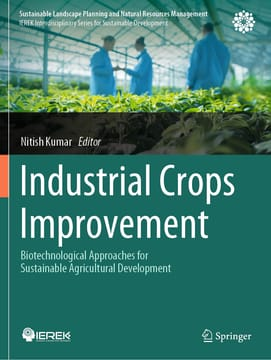
Industrial Crops Improvement: Biotechnological Approaches for Sustainable Agricultural Development (en Inglés)
Nitish Kumar
Industrial Crops Improvement: Biotechnological Approaches for Sustainable Agricultural Development (en Inglés)
Nitish Kumar (Autor) · Springer Nature Switzerland · Tapa Blanda
Quedan más de 100 unidades
S/ 686,40Industrial Crops Improvement: Biotechnological Approaches for Sustainable Agricultural Development (en Inglés)
Nitish Kumar
This book explores the different conventional and biotechnological techniques for enhancing the productivity of industrial crops. The growth of the industrial crop sector has become a widespread global phenomenon that helps rural livelihoods and propels economic development. Contrary to staple crops, industrial crops are cultivated with the intention of being sold for a high profit. Industrial crops are a crucial component of plans to increase food security because they offer the required stability during periods of economic or climatic crises. In order to maintain their livelihood and food security, many farm households balance the advantages and disadvantages of producing food crops and industrial crops. Avoiding land-use rivalry with crops grown for food and feed production is crucial when considering growing industrial crops on agricultural soils.
The past several years have seen a rise in the awareness of scholars and decision-makers regarding the immediate and long-term effects of climatic variables on economic, food security, social, and political results. In order to sustain food production with more climate-resilient crops for future generations, genetic variety, both natural and artificial, is crucial. Therefore, addressing the problem of finding a compromise between increasing crop production under a specific set of conditions and reducing the chance of crop failure when conditions change is important and difficult. An assortment of meteorological conditions is used to grow industrial crops. Many are subsistence farmers who run extremely tiny farms with very little agricultural input to produce products that can be sold. It is a significant problem to preserve the variety of these crops and handle all crop culture-related difficulties. By offering the knowledge required to minimize the dangers of industrial crop breeding through managing genetic diversity, the author believe that this book will primarily address a need that has not yet been met in this and other grower groups.
¿Tienes una pregunta sobre el libro? Inicia sesión para poder agregar tu propia pregunta.