
Enviar a
CERCADO DE LIMA, Lima
Selecciona tu ubicación
Los costos de envío se calcularán en base a esta dirección en todo el sitio.
Los costos de envío se calcularán en base a esta dirección en todo el sitio.
Selecciona tu país
América
Argentina
Brasil
Canadá
Chile
Colombia
Costa Rica
Ecuador
El Salvador
Estados Unidos
México
Perú
República Dominicana
Uruguay
Europa
Alemania
Austria
Bélgica
Croacia
Dinamarca
Eslovaquia
Eslovenia
España
Finlandia
Francia
Grecia
Hungría
Irlanda
Italia
Letonia
Malta
Noruega
Países Bajos
Polonia
Portugal
Reino Unido
República Checa
Serbia
Suecia
Suiza
Resto del mundo
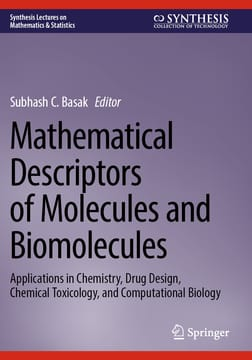
Mathematical Descriptors of Molecules and Biomolecules: Applications in Chemistry, Drug Design, Chemical Toxicology, and Computational Biology (en Inglés)
Subhash C. Basak
Mathematical Descriptors of Molecules and Biomolecules: Applications in Chemistry, Drug Design, Chemical Toxicology, and Computational Biology (en Inglés)
Subhash C. Basak (Autor) · Springer International Publishing · Tapa Blanda
Quedan más de 100 unidades
S/ 163,90Mathematical Descriptors of Molecules and Biomolecules: Applications in Chemistry, Drug Design, Chemical Toxicology, and Computational Biology (en Inglés)
Subhash C. Basak
This book provides an up-to-date overview of data driven and evidence-based empirical approaches in the efficient application of chemodescriptors and biodescriptors. Currently there is a steady increase in the use of data analytics and model-based decision support systems in basic and applied research in chemoinformatics, bioinformatics, pharmaceutical drug design, predictive toxicology, and computational biology. Since there are a plethora of modeling methods and a large number of chemodescriptors and biodescriptors available today, robust statistical and machine learning methods are applied throughout. In addition, the development of statistically robust predictive models in rank deficient cases using chemodescrip tors and biodescriptors is discussed. Readers are provided with an up-to-date overview of the theoretical background, calculation methods, and proper use of chemodescriptors and biodescriptors in model building, with special emphasis on computer-assisted organic synthesis, new drug discovery, hazard assessment of chemicals, and computational biology of emerging global pathogens. The book also discusses the applications of alignment-free sequence descriptors (AFSDs) in vaccine design and the characterization of emerging global pathogens such as the Zika virus and SARS-CoV-2. The utility of molecular fragment-based descriptors in building useful quantitative structure-activity relationship (Q)SAR) models is detailed as is the use of mathematical structural descriptors in chemical synthesis planning.
¿Tienes una pregunta sobre el libro? Inicia sesión para poder agregar tu propia pregunta.