Nos volvimos LOCOS - Hasta 60% dto durante 72 horas  Ver más

Enviar a
CERCADO DE LIMA, Lima
0
  • argentina
  • chile
  • colombia
  • españa
  • méxico
  • perú
  • estados unidos
  • internacional

Selecciona tu país

América

Europa

Resto del mundo

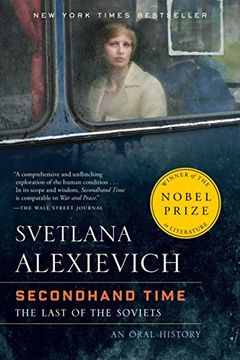
portada Secondhand Time: The Last of the Soviets (en Inglés)
Formato
Libro Físico
Traducido por
Año
2017
Idioma
Inglés
N° páginas
496
Encuadernación
Tapa Blanda
Dimensiones
20.3x14.2x3 cm
Peso
0.39 kg.
ISBN13
9780399588822

Secondhand Time: The Last of the Soviets (en Inglés)

Svetlana Alexievich (Autor) · Alexievich Svetlana (Autor) · Bela Shayevich (Traducido por) · Random House Trade · Tapa Blanda

Secondhand Time: The Last of the Soviets (en Inglés) - Svetlana Alexievich; Alexievich Svetlana

Más barato Libro Nuevo Importado
Envío: 13 a 18 días háb.
S/ 222,89S/ 100,30
-55%
Más rápido Libro Nuevo Importado
Envío: 11 a 17 días háb.
S/ 220,35S/ 132,21
-40%
Costos de importación incluídos en el precio ✅
Libro Nuevo Más barato

Última Unidad

S/ 100,30
Llega entre el 15 Oct y el 23 Oct a CERCADO DE LIMA, Lima. Seleccionar ubicación

Reseña del libro "Secondhand Time: The Last of the Soviets (en Inglés)"

NEW YORK TIMES BESTSELLER - A symphonic oral history about the disintegration of the Soviet Union and the emergence of a new Russia, from Svetlana Alexievich, winner of the Nobel Prize in LiteratureNAMED ONE OF THE TEN BEST BOOKS OF THE YEAR BY THE WASHINGTON POST AND PUBLISHERS WEEKLY - LOS ANGELES TIMES BOOK PRIZE WINNER NAMED ONE OF THE BEST BOOKS OF THE YEAR BY The New York Times - The Washington Post - The Boston Globe - The Wall Street Journal - NPR - Financial Times - Kirkus Reviews When the Swedish Academy awarded Svetlana Alexievich the Nobel Prize, it cited her for inventing "a new kind of literary genre," describing her work as "a history of emotions--a history of the soul." Alexievich's distinctive documentary style, combining extended individual monologues with a collage of voices, records the stories of ordinary women and men who are rarely given the opportunity to speak, whose experiences are often lost in the official histories of the nation. In Secondhand Time, Alexievich chronicles the demise of communism. Everyday Russian citizens recount the past thirty years, showing us what life was like during the fall of the Soviet Union and what it's like to live in the new Russia left in its wake. Through interviews spanning 1991 to 2012, Alexievich takes us behind the propaganda and contrived media accounts, giving us a panoramic portrait of contemporary Russia and Russians who still carry memories of oppression, terror, famine, massacres--but also of pride in their country, hope for the future, and a belief that everyone was working and fighting together to bring about a utopia. Here is an account of life in the aftermath of an idea so powerful it once dominated a third of the world. A magnificent tapestry of the sorrows and triumphs of the human spirit woven by a master, Secondhand Time tells the stories that together make up the true history of a nation. "Through the voices of those who confided in her," The Nation writes, "Alexievich tells us about human nature, about our dreams, our choices, about good and evil--in a word, about ourselves." Praise for Svetlana Alexievich and Secondhand Time "The nonfiction volume that has done the most to deepen the emotional understanding of Russia during and after the collapse of the Soviet Union of late is Svetlana Alexievich's oral history Secondhand Time."--David Remnick, The New Yorker
Svetlana Alexievich
  (Autor)
Ver Página del Autor
La escritora Svetlana Alexievich es conocida por su innovador enfoque narrativo que combina el testimonio oral y la literatura para explorar los grandes acontecimientos y tragedias del siglo XX y XXI. Nacida el 31 de mayo de 1948 en Stanislav (hoy Ivano-Frankivsk, Ucrania), Alexievich creció en Bielorrusia, donde su familia se estableció poco después de su nacimiento.

Tras estudiar periodismo en la Universidad de Minsk, Alexievich trabajó como profesora, reportera y editora, desarrollando un interés particular en las historias individuales de personas comunes afectadas por eventos históricos. Este enfoque distintivo la llevó a crear un estilo literario único, que ella misma define como "novelas de voces".

Su primer libro, La guerra no tiene rostro de mujer (1983), recopiló los relatos de mujeres soviéticas que participaron en la Segunda Guerra Mundial, revelando sus experiencias desde una perspectiva íntima y nunca antes explorada. Esta obra, al igual que muchas de las siguientes, se encontró con la censura de las autoridades soviéticas, pero también recibió gran reconocimiento por su autenticidad y profundidad.

Otras de sus obras más influyentes incluyen Los muchachos de zinc (1989), que aborda las experiencias de los soldados soviéticos en la guerra de Afganistán, y Voces de Chernóbil (1997), un estremecedor relato coral sobre la tragedia nuclear de 1986. Estos libros, junto con El fin del "Homo sovieticus" (2013), han consolidado a Alexievich como una de las cronistas más importantes del mundo pos-soviético.
Ver más
Ver menos

Opiniones del libro

Preguntas frecuentes sobre el libro

Todos los libros de nuestro catálogo son Originales.
El libro está escrito en Inglés.
La encuadernación de esta edición es Tapa Blanda.

Preguntas y respuestas sobre el libro

¿Tienes una pregunta sobre el libro? Inicia sesión para poder agregar tu propia pregunta.

Opiniones sobre Buscalibre

Ver más opiniones de clientes