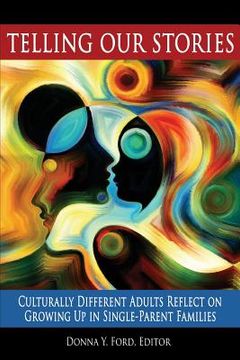
Telling Our Stories: Culturally Different Adults Reflect on Growing Up in Single‐Parent Families (en Inglés)
Reseña del libro "Telling Our Stories: Culturally Different Adults Reflect on Growing Up in Single‐Parent Families (en Inglés)"
Five decades ago, I was challenged to read the Moynihan Report (1965). Then and now, I take issue with much of the content, which smacks of deficit thinking, blaming the victim, and a blindness or almost total disregard for how systemic racism and social injustices contribute to family structures. I recall being professionally and personally offended by interpretations of single‐parent families, which were often negative and hopeless. Moral development, criminal activity, poor educational outcomes, poverty, and apathy of many kinds were placed squarely on the shoulders of these families, especially if the families were/are headed by Black mothers. Eurocentric and middle class notions of 'real' families like those depicted on TV shows and movies dominate, then and now, what is deemed healthy in terms of family structures - with the polemic conclusion that nuclear families are the best and sometimes only structure in which children must be raised. These colorblind, economic blind, and racist blind studies, reports, theories, and folktales have failed to do justice to the families in which there is one caregiver. Their stories of woe and mayhem make the news and guide policies and procedures. The stories of children who have been resilient have been unheard and silenced, they have been under‐reported and relegated to the status of 'exception to the rule'. Perhaps they are exceptions, but there are more exceptions than we may know. This book is designed with those stories of resilience and success in mind. The book is not an attempt to glorify single‐parent families, but such families are prevalent and increasing. High divorce rates are impactful. And some parents have chosen to not marry, which is their right. While not glorifying single‐parent families, we are also not demonizing them or telling their stories void of context. Yes, income will often be low(er), time will be compromised when divided between offspring, work, and other obligations. Likewise, we are not glorifying two‐parent families as being ideal; their context matters too. How healthy are married couples who don't really love or even like each other? How healthy are those parents who have separate sleeping arrangements/bedrooms? How healthy are those families who have oppositional parenting styles and goals for their children? This is the 50th anniversary of the Moynihan Report, and I am concerned that another 50 years will pass that fails to balance out the stories of single‐parent families, mainly those whose children succeed and defy the odds so often unexpected of them. I agree with Cohen, co‐author of the updated report: "The preoccupation with strengthening marriage as the best route to reducing poverty and inequality has been a policymaking folly". Further, 50 years after Moynihan released the controversial report, The Negro Family: The Case for National Action, a new brief by the Institute for Women's Policy Research (IWPR) and the Council on Contemporary Families (CCF) titled, "Moynihan's Half Century: Have We Gone to Hell in a Hand Basket?," finds that the changes in family structure that concerned him have indeed continued, becoming widespread among Whites as well, but that they do not explain recent trends in poverty and inequality. In fact, a number of the social ills Moynihan assumed would accompany these changes in family structure--such as rising rates of poverty, school failure, crime, and violence--have instead decreased. (see: http: //www.streetinsider.com/Press+Releases/The+Moynihan+Report+at+50% 3A+New+Report+Finds+that+the+Rise+of+Single+Mothers+Does+Not+Explain+Poverty+Rates+Fully/10344482.html)